circuit design


Controlling a LED with Arduino

  • avatar
  • 4.3K Views
  • 6 mins read
Preview image

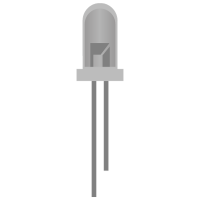
Light Emitting Diodes (LEDs) are incredibly adaptable components often employed in electronics projects for various purposes, from indicating status to creating captivating lighting effects. When it comes to managing LEDs with an Arduino, you have the option of utilizing either digital pins or Pulse Width Modulation (PWM) pins. In this article, we'll explore the advantages of each method and provide you with a comprehensive guide on how to control LEDs using an Arduino.

Using transistors in electronic circuits

  • avatar
  • 4.3K Views
  • 2 Likes
  • 7 mins read
Preview image

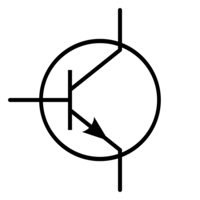
Transistors are fundamental semiconductor devices that revolutionized the world of electronics. Among various types of transistors, Bipolar Junction Transistors (BJTs) hold significant importance due to their widespread use in amplification, switching, and signal processing applications. This article will explore the two main types of BJT transistors: NPN and PNP. We will explore their basic structures, operating principles, and essential circuit elements required for their proper functioning.

How to use an analog module with Arduino

  • avatar
  • 4.7K Views
  • 1 Like
  • 4 mins read
Preview image

The KY-023 is an easy-to-use analog joystick. The joystick uses a biaxial potentiometer to control the X and Y axis. It also has an integrated push button. In this tutorial, it is shown how to connect the KY-023 joystick with the Arduino and how to use it.

 Join Our Monthly Newsletter

Get the latest news and popular articles to your inbox every month

We never send SPAM nor unsolicited emails

Using touch sensor with Arduino

  • avatar
  • 4.5K Views
  • 4 mins read
Preview image

Touch sensor (also known as touch button) is widely used to control devices. It detects touch, force or pressure on its surface changing the logic state of the circuit. Actually, it works in very similar way as to buttons. Checkout the wiring and Arduino code implementation to track the current state and the state changes.

Pressure and temperature measurement with GY-65

  • avatar
  • 4.2K Views
  • 1 Like
  • 5 mins read
Preview image

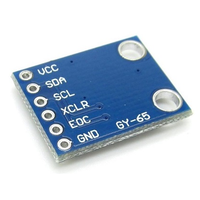
Precision monitoring of atmospheric conditions becomes a reality with the GY-65 module based on BMP085 sensor. Armed with the ability to measure temperature, pressure, and altitude, the GY-65 module opens up a world of possibilities for weather stations, altitude tracking devices, and other projects requiring accurate environmental data. In this article, we delve into the capabilities of the module, examining its features, connectivity with Arduino.

Using push buttons with Arduino

  • avatar
  • 4.7K Views
  • 2 Likes
  • 4 mins read
Preview image

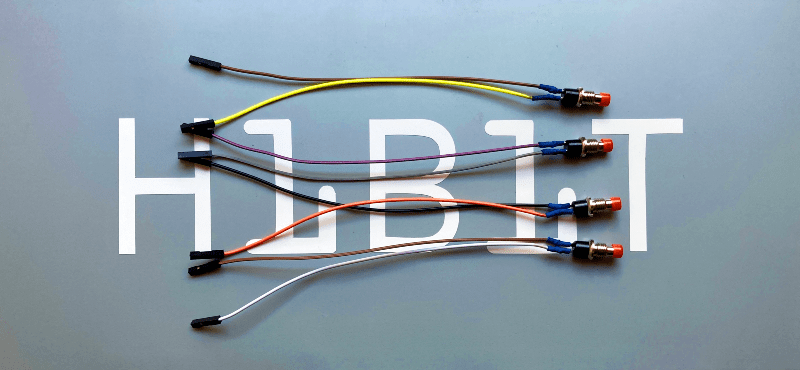
Today we are going to speak about push buttons, the wiring and how to implement the code for this circuit elements in Arduino. Push buttons connect two points in a circuit when you press them. That means that logic state of the circuit change when you press and keep pressed the button.

How to use tricolor LED module with Arduino

  • avatar
  • 4.3K Views
  • 3 Likes
  • 4 mins read
Preview image

The KY-016 is capable of producing wide range of different colors by mixing blue, green and red lights. The RGB LED module will not require any limiting resistors. Those resistors are already integrated in the circuit, and so 5V can be directly used as power input.

Using switch buttons with Arduino

  • avatar
  • 3.8K Views
  • 3 Likes
  • 4 mins read
Preview image

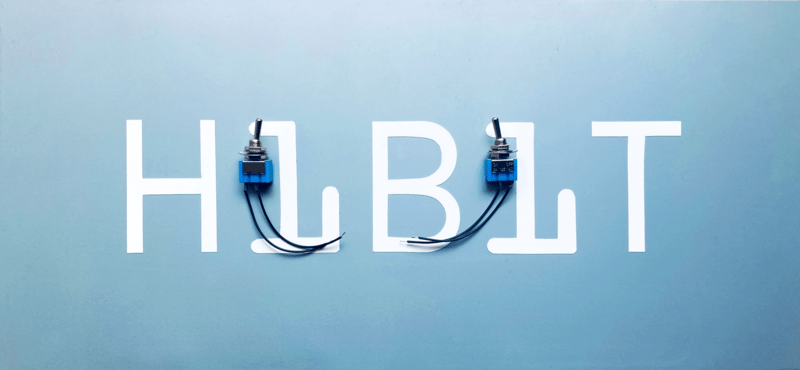
Let's speak now about switch buttons, the wiring and how to implement the code for this circuit elements in Arduino. Switch buttons connect two points in a circuit when you press them and maintain the state without the need to keep the button pressed. That means that logic state of the circuit change every time you press the button.

Connecting tilt sensor with Arduino

  • avatar
  • 3.4K Views
  • 1 Like
  • 5 mins read
Preview image

A tilt sensor is a type of sensor that can detect the orientation or tilt of an object relative to the force of gravity. It works by measuring the change in angle of the object with respect to the vertical axis.

Tilt sensors can be found in various forms, such as simple mechanical switches, mercury switches, and electronic sensors. They are commonly used in applications that require the detection of tilting or changes in orientation, such as in construction equipment, automotive safety systems, robotics, and gaming controllers.

Simple steps for building circuits with breadboards

  • avatar
  • 2.9K Views
  • 6 mins read
Preview image

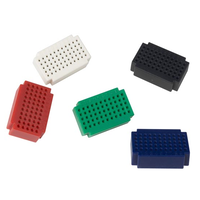
A breadboard is an essential tool for working with electronics. It provides a quick and convenient way to test, build, and modify circuits without soldering. Named after the wooden boards originally used to organize components, modern breadboards are plastic boards filled with a grid of tiny holes and internal connectors. This structure lets you easily plug in components and wires, making it ideal for experimenting and prototyping before committing to a permanent setup.